
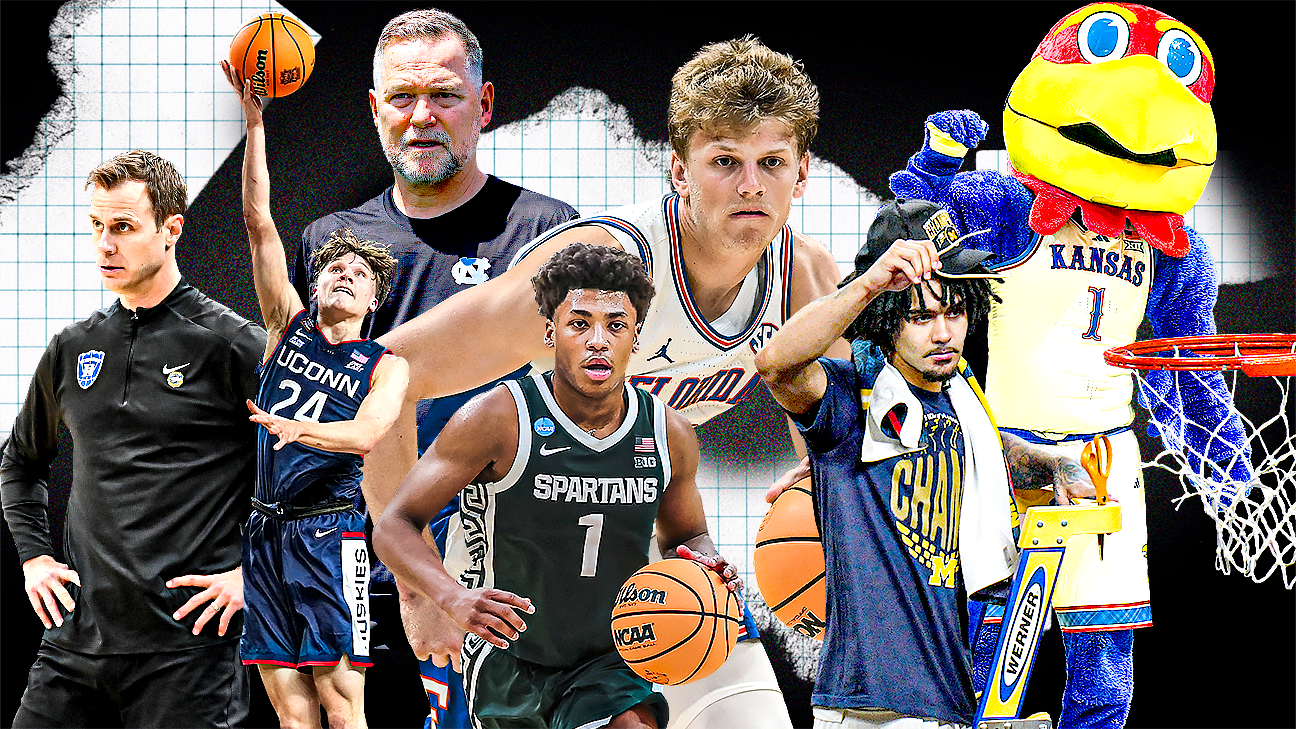
We're just over halfway through the offseason of no college basketball. A little more than 100 days ago, Michigan cut down the nets in Indianapolis for its first national championship in 37 years. In less than 100 days, the Wolverines will begin their title defense, looking just a little different.
Can new coach Mike Boynton and his new roster pick up where Dusty May left off before the latter's surprise departure for the NBA? Who are the challengers? Florida, which did the unthinkable and kept its 2025 title-winning core intact for a third consecutive season? A UConn program with dynasty dreams? Duke with a coach coveted by the NBA?
Then there are the larger, sport-level changes that went into effect: new eligibility rules that were followed by a slew of lawsuits, throwing the question of who can play in a few months into murky waters. The NCAA tournament has also, after years of speculation, finally expanded. Eight more teams will now hear their name called on Selection Sunday.
There's a lot to know if you stopped paying attention to college basketball after "One Shining Moment" played in April. So, consider this your primer: ESPN's Jeff Borzello and Myron Medcalf on 10 storylines plus 90 more things to know about the upcoming season, from wild predictions to the top players, new coaches and more.
Jump to: Top storylines | Wild predictions Contenders | Teams that could make a jump Best nonconference matchups Freshmen | Transfers | Breakouts All-America candidates | New coaches
10 storylines that could shape the season How will Michigan defend its title without Dusty May and three lottery picks? Michigan's march to a national championship last season was one of complete dominance. The Wolverines romped to a Players Era title in November with a plus-110 scoring margin over three games, won 29 games by double digits, and defeated teams by an average of 19 points per game in the NCAA tournament. Unsurprisingly, their entire frontcourt departed for the NBA as lottery picks. And then came the stunner: Dusty May became the first men's college basketball coach to leave in the offseason immediately following a national title since 1988, when Larry Brown left Kansas in late June for the Dallas Mavericks.
Dan Hurley will now turn to Mullins to chase his third national title in five seasons. Thomas Haugh, also a projected lottery pick, is back in Gainesville, Florida, to chase another championship two years after he won it all with Florida. Alex Condon and Rueben Chinyelu will join him, locking up the nucleus of the Gators' championship frontcourt.
Michael Malone starts a new era at North Carolina. Malone, the championship-winning former NBA coach, was working for ESPN in April when he received the call to replace Hubert Davis, the former UNC star who was fired following a series of lackluster showings during his five-year tenure. Three years removed from leading the Denver Nuggets, and 25 years after his last stint in the Division I ranks (he was an assistant at Manhattan from 1999 to 2001), it makes sense the school would turn to a leader accustomed to the roster chaos and financial transactions attached to transfer portal moves and NIL deals.
But the past 10 years have not been kind to NBA coaches who tried to adapt to the college game. Both levels of basketball have their own unique challenges, and although Malone has an NBA title, he's a newcomer in this landscape. His predecessor had All-Americans and lottery picks and still fell short of expectations in Chapel Hill.
Bill Self is on retirement watch as he coaches another potential No. 1 pick. After losing to St. John's in the NCAA tournament, the longtime Kansas head coach seemed uncertain about his future. "I love what I do; I need to be able to do it where I'm feeling good and healthy to do it fairly well," Self said at the time. "I'll get back home, and it'll all be discussed."
A week later, he backtracked and announced his return to Lawrence, saying he was "committed" to Kansas. That hasn't quieted the speculation about the future of the legendary head coach who has battled health challenges in recent years.
The arrival of Tyran Stokes, the potential No. 1 pick in the 2027 NBA draft, might have contributed to Self's newfound enthusiasm about his coaching future. In Stokes, the Jayhawks will have a player with NBA dreams and a versatility that could fuel their first Final Four run since their national title in 2022. It must be acknowledged that Kansas had similar projections a year ago with Darryn Peterson. Yet, the team never hit its stride amid a turbulent season for Peterson.
Rampant eligibility questions remain entering the stretch run of the offseason. We're less than 100 days from the start of the season, and there are still dozens and dozens of players in eligibility limbo.
In May, the NCAA laid out new guidance regarding eligibility for international players, including updated requirements for compensation players received while playing in Europe. An NCAA spokesperson told Sports Illustrated at the time that the NCAA "identified several international leagues in which participation by a prospect is likely to result in violations of NCAA rules and a loss of eligibility."
The guidance came weeks after the largest Europe-to-NCAA exodus we've seen, leading to rampant questions about whether the majority of the European stars coming to college basketball will be cleared to play.
The second, arguably bigger, sticking point is the new age-based eligibility model that gives athletes five years of eligibility over five seasons. The new rules were put into effect for student-athletes graduating next spring but not retroactively applied to those who graduated this past spring. This new "five-in-five" rule has led to a raft of lawsuits and legal challenges from graduating seniors arguing for a fifth year of eligibility.
Mark Pope enters the season under pressure. Kentucky beat then-No. 1 Purdue in a preseason exhibition game last October and entered Year 2 of the Mark Pope era with sky-high expectations, a highly ranked transfer class, reportedly the highest-paid roster in the sport and plenty of momentum in the program.
It unraveled pretty quickly. The Wildcats started 5-4 overall, lost their first two games of the SEC season, and after an impressive stretch midway through conference play lost five of their final seven games of the regular season before limping out of the NCAA tournament with a 19-point loss to Iowa State in the second round.
But this is the new LSU. Kim Mulkey is still wearing her colorful outfits on the sidelines. The school stole Lane Kiffin from Ole Miss to lead its football program, and Kiffin added Ed Orgeron, who won a national title at LSU in 2019 before being fired. It only makes sense Wade would return, too. In Baton Rouge, the band is back together.
The Pac-12 is back, sort of, at the expense of the WCC. The conference realignment conversation has centered on college football in recent years, but the loss of the Pac-12 more significantly removed the West Coast's traditional footprint in basketball. The league managed to find a way to return this season, without the prominent schools that comprised the former version. It does have new members in Gonzaga, along with Boise State, Colorado State, San Diego State and Utah State -- all teams with recent NCAA tournament appearances, and even runs, on the résumé.
Welcome to the newly expanded NCAA tournament. After more than three years of discussions and debates, the NCAA finally made the long-anticipated decision official: The men's and women's tournaments are expanding by eight teams to fields of 76, effective this coming season. There will now be 44 at-large bids to go with 32 automatic bids (the return of the Pac-12 means an additional automatic qualifier).
The biggest change from a logistical and bracketing perspective? The First Four is out; the Opening Round is in. There will now be 24 teams playing in 12 games for a chance to advance to the men's round of 64, as opposed to eight teams playing in four games. Half of the games will take place in Dayton, where the First Four has typically been hosted, while the other half will be played in Wichita, Kansas.
10 title contenders Teams listed in order of Borzello and Medcalf's consensus top 10
Thomas Haugh, Alex Condon, Rueben Chinyelu -- that led the Gators to a national championship two years ago and a 1-seed last season. Boogie Fland is also back at point guard, and the Gators are holding out hope that a fourth key player from that title team, Denzel Aberdeen, gets another year of eligibility. -- Borzello
UConn is chasing its third title in five years -- could hinge, however, on Duke transfer Nikolas Khamenia's ability to fill the massive void created by the departure of Tarris Reed Jr. -- Medcalf
A "jump" meaning into the national spotlight, into the top tier of their conference or onto the NCAA tournament bubble. Listed in alphabetical order.
Games are listed in chronological order.
Listed in order of their SC Next 100 ranking.
Tyran Stokes, SF, Kansas. The No. 1 recruit in the country and early projected No. 1 pick in the 2027 NBA draft, Stokes is a matchup nightmare for opponents. His strength makes him a menace slashing to the rim, but he is also capable of creating for others and is an excellent passer.
Jordan Smith, G, Arkansas. Smith is a winner and a leader and that should be evident immediately in Fayetteville. He is a terrific two-way performer, establishing himself as one of the elite defenders in the class and capable of playing either backcourt position.
Caleb Holt, SG, Arizona. The Wildcats' highest-ranked recruit in nearly a decade will make an impact at both ends of the floor from day one. He's a terrific defender who can guard multiple positions and will look to make plays while getting downhill with the ball in his hands.
Cameron Williams and Joaquim Boumtje Boumtje, PF, Duke. Jon Scheyer will likely have to start at least one of these two five-stars. Williams is a top-five recruit with enormous long-term potential, while Boumtje Boumtje turned heads all spring and summer on the international circuit.
Bruce Branch III, SF, BYU. Branch has huge shoes to fill. While not at the level of AJ Dybantsa, the No. 1 pick in the 2026 draft, he is one of the best pure scorers in the 2026 class. He has size, he has length and he possesses the ability to make shots over defenders or catch-and-shoot from the perimeter.
Jason Crowe, PG, Missouri. It wouldn't be a surprise to see Crowe put up the best numbers in the freshman class next season. He led the Nike EYBL in scoring and is arguably the most explosive player in the class in terms of getting by his defender and putting pressure on the defense.
Anthony Thompson, SF, Ohio State. Thompson is Ohio State's highest-ranked men's basketball recruit in a decade, and Jake Diebler will be counting on him to produce right away. He can really shoot it from the perimeter and is capable of scoring at all three levels.
Miles Sadler, PG, West Virginia. Sadler steadily rose up the 2026 SC Next rankings, capped by a fantastic showing at the Nike Hoop Summit in April. He's a tremendous playmaker, and his speed is a difference-maker; defenders find it difficult to keep him out of the lane off the bounce.
Quentin Coleman, SG, Illinois. Coleman initially committed to Wake Forest before reopening his recruitment in the spring and heading to Champaign. He is already generating potential one-and-done buzz, despite being unranked until late in his high school career.
Listed in order of their transfer rankings.
Milan Momcilovic, SF, Kentucky (No. 1): Momcilovic was the best shooter in the country last season and the best player in the portal. The former Iowa State star should be a foundational piece for Mark Pope, providing the Wildcats with a legitimate go-to guy offensively in what will be a critical season for the program's head coach.
John Blackwell, SG, Duke (No. 3): The best guard in the portal, Blackwell earned All-Big Ten honors after averaging 19.1 points and 5.1 rebounds at Wisconsin last season. He'll fill a huge need for Jon Scheyer, as the Blue Devils lacked a go-to scorer a year ago alongside Caleb Foster and Dame Sarr on the perimeter.
Tounde Yessoufou, SF, St. John's (No. 4): Yessoufou didn't withdraw from the NBA draft until just before the deadline. Then he committed to St. John's minutes after it passed. He is an elite scorer who averaged 17.8 points as a freshman at Baylor, and he will be needed even more with Donnie Freeman's recent Achilles injury.
Stefan Vaaks, G, Illinois (No. 9): Vaaks was one of the surprise freshmen in college basketball last season, averaging 15.8 points and 3.2 assists at Providence. Now, the Estonia native heads to Champaign, where he will likely be handed more responsibility as a playmaker, and create matchup issues with his 6-7 size.
Moustapha Thiam, C, Michigan (No. 10): Given the strides Morez Johnson Jr. and Aday Mara took last season, there should be optimism Thiam can reach his ceiling in Ann Arbor, too. He was tremendous down the stretch of last season, posting 18.0 points and 10.4 rebounds in his final eight games at Cincinnati.
Acaden Lewis, PG, Miami (No. 13): Jai Lucas nailed his picks from the portal last season, and Lewis is the headliner for this season's incoming transfer group. He's a stellar two-way point guard, one who averaged 12.1 points, 5.3 assists and 1.9 steals as a freshman at Villanova last season.
Amari Allen, F, Alabama. The 6-8 forward, who earned a spot on the all-SEC freshman squad after scoring 15 points or more in six league games, is ready for a bigger role in Nate Oats' offense. After recording double figures in the first and second rounds of the NCAA tournament, he has shown he can handle more.
Malachi Moreno, C, Kentucky. The 7-foot sophomore made the right move to withdraw from the NBA draft and return to Lexington, where he'll get another chance to learn under Mark Pope, a former NBA center himself, and improve on last season's 59% shooting from inside the arc.
Ivan Kharchenkov, F, Arizona. Prior to a lackluster effort in a Final Four loss to Michigan, Kharchenkov averaged 14.0 PPG and 6.5 RPG in the NCAA tournament. The 6-7 standout is poised to become a star under Tommy Lloyd in his sophomore season.
Tyler Perkins, G, Villanova. Perkins is the only returning player who averaged in double figures (13.7 PPG, 37% from 3) last season. The 6-4 guard flew under the radar a year ago, but a borderline top-25 Villanova squad will draw more attention if his growth continues.
Amari McCottry, F, Saint Louis. In his team's lopsided second-round loss to Michigan in March, the 6-6 McCottry (14 points, 7-for-11 from the field) was the best player for the Billikens. Saint Louis lost its top two scorers from last season, and will accordingly look to McCottry to put together a complete, dominant campaign.
Amare Bynum, F, Ohio State. Late last season, the 6-8 forward put together four consecutive double-figure efforts. The young standout, who made 62% of his shots inside the arc in Year 1, will aim to push Ohio State into the top tier of the Big Ten in Year 2.
C.J. Cox, G, Purdue. Now that Braden Smith, Fletcher Loyer and Trey Kaufman-Renn have all graduated, it's Cox's turn to be a leader for Matt Painter's program. He was seventh on the team in usage rate a year ago, but the 37% 3-point shooter will get more opportunities now.
Jeremy Fears Jr., G, Michigan State. The favorite to win the Wooden Award, Fears (15.2 PPG, 9.4 APG) is surrounded by offensive playmakers and experience to help Tom Izzo capture his second national championship. He'll also chase the NCAA record books a season after recording 328 assists, the No. 6 mark in college basketball history.
Tyran Stokes, SF, Kansas. At 6-7, Stokes is one of the strongest and most versatile talents Bill Self has ever coached. If he can smooth some of the edges of his game and become a consistently focused player, Stokes could be the No. 1 pick in the 2027 NBA draft.
Thomas Haugh, F, Florida. Haugh (17.1 PPG, 6.1 RPG, 57% FG), a third-team AP All-American last season, picked one more year at Florida, another shot at a second national championship and a hefty NIL package over a spot in the first round of the NBA draft. As a result, he's a candidate for every individual honor in the country entering the season.
Tyler Tanner, G, Vanderbilt. Tanner (19.5 PPG, 37% from 3) returned to college to prove to the decision-makers at the next level that he can be a reliable defensive presence and not just an elite scorer. His scoring touch, however, is the reason Vanderbilt will begin the season as a top-25 squad.
John Blackwell, G, Duke. The former Wisconsin star earned All-Big Ten third team honors after averaging 19.1 PPG and connecting on 39% of his 3-point attempts for the Badgers. In Durham, he'll have a fleet of NBA prospects and veterans to expand his game and star power in the ACC.
Elliot Cadeau, G, Michigan. On a team with three future lottery picks, Cadeau secured Most Outstanding Player of the Final Four, scoring 19 points and picking up a pair of key steals in the national title game. He keeps improving with every season, and his return is a boost for Mike Boynton and the start of the next chapter in Ann Arbor.
Michael Malone, North Carolina. One of the most surprising hires of the carousel came at one of the biggest jobs in the sport. Malone won 510 games and an NBA championship in 12 seasons with the Denver Nuggets but hasn't coached in college since his days as a Manhattan assistant in 2001. He already has put together what should be a top-25 roster, though, and has hit the ground running on the recruiting trail.
Boynton was able to keep nearly the entire group together following May's departure -- and there should be some defensive continuity from last season's top-ranked defense given he was the team's defensive coordinator.
Will Wade, LSU. Wade's return to Baton Rouge wasn't the cleanest of transitions, with the Tigers' pursuit of its former coach playing out publicly while Matt McMahon was still in charge of the program. But now that Wade is back in the fold, the wins should follow. Since LSU fired him in 2022, Wade won 58 games in two seasons at McNeese and led NC State to the 2026 NCAA tournament.
Bryan Hodgson, Providence. Hodgson has developed a reputation for punching above his weight on the recruiting trail and quickly turning around programs, having already done so at South Florida and Arkansas State. He had one of the best transfer classes in the Big East this spring and has the Friars hoping to get back to the NCAA tournament for the first time since 2023.
Gerry McNamara, Syracuse. The Orange went to a program legend to try to return to their glory days. McNamara was the head coach at Siena for two seasons after 15 years as a Syracuse assistant under Jim Boeheim and Adrian Autry. As a player, he had one of greatest Orange careers of all time, including a national championship in 2003.
Jerrod Calhoun, Cincinnati. Calhoun returns home after leading Utah State to back-to-back NCAA tournament appearances, with last season's trip including a win over Villanova. The Cincinnati graduate began his coaching career as a student assistant under Hall of Famer Bob Huggins. His first Bearcats roster includes 11 transfers and zero returnees.
Luke Murray, Boston College. Considered one of the sport's elite offensive tacticians, Murray was part of the Huskies' back-to-back title-winning staffs. He'll now look to bring those winning ways to Chestnut Hill, which hasn't seen an NCAA tournament team since 2009. He already has upgraded the program's talent with an underrated portal class.
Randy Bennett, Arizona State. After years of speculation that he would leave Saint Mary's, Bennett finally made the jump, heading back to his home state after 25 years with the Gaels. He was able to convince all-league forward Paulius Murauskas to follow him to Tempe, which should help in Year 1.
Casey Alexander, Kansas State. Alexander led Belmont to the Missouri Valley regular-season title last season, his 10th straight campaign with at least 20 wins. He will replace Jerome Tang, who was let go toward the end of his fourth year. Will Alexander's efficient offensive system translate to the Big 12?