
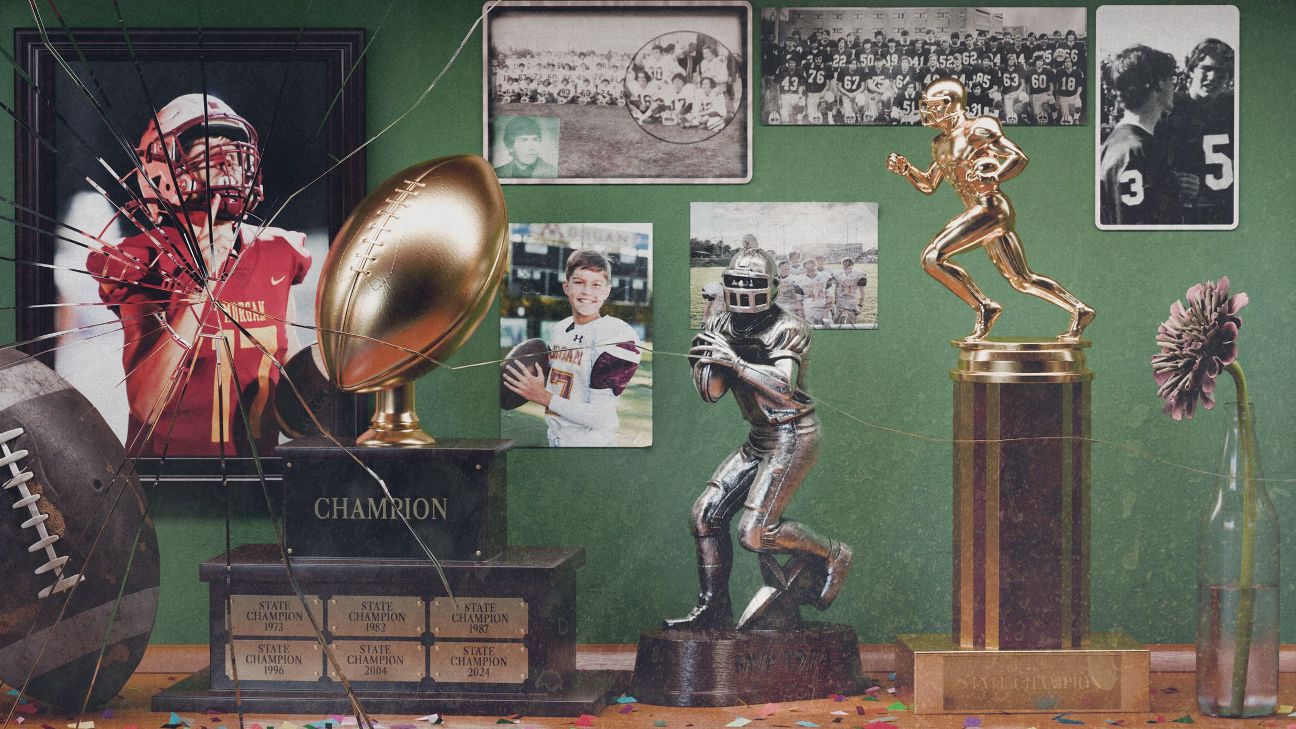
One would be entering his old age now, with most of a long life behind him. The other would just be entering his senior year in high school, working to fulfill a life of great promise.
But nobody knows them now except by memory, so time is also what ties them together.
And it is time that tells their story.
They were both so young, are both so young still.
It's the last thing Caden Tellier ever says.
Without hesitation, Harry slaps his son across the face, hard. Jim Savage is horrified, but what he will remember most vividly, what he will remember forever, is Jay's response. The boy doesn't cry. He doesn't even flinch. He just ... takes it, as if endurance has already become his calling and his fate.
"Should I bring a pizza?" He arrives late, pizza in hand, and explains to the group that he doesn't know why, but he had to come. Then he becomes impassioned. He's a determinedly soft-spoken kid, but he speaks with such conviction that he causes his pastor to abandon her planned lesson. He might want to see his jersey retired, but what he really wants to see is a spiritual revival of his team. Then he stops himself. "No," he says, "I want to see a revival at school ..."
Two nights later, he leads his team onto the field for a game against Greensboro, Alabama's Southern Academy, with his father up in the booth calling plays.
THERE SHOULD BE NO PROBLEM with the snap. The quarterback and the center, Jay Kutner and Richie Callahan, are best of friends, one of them tall and the other so squat he's called "Stumpy." They've practiced the exchange all summer, in preparation for their senior season. Jay has taken hundreds of snaps, until receiving the ball from Stumpy has become second nature to him, just like their friendship. But when preseason begins and the team goes to camp at a nearby seminary, there is a complication. Holy Trinity's head coach, Fred Bruno, has hired a new offensive assistant, an odd, persnickety man with a crewcut and a deep ideological commitment to the University of Delaware's wing-T offense. Crewcut sweats the smallest details, even the snap from center. His center and his quarterback exchange the ball as they have since they started playing football, Richie turning the ball on the upswing so Jay can grab it across the laces. Crewcut tells them they're doing it wrong. He insists on Jay grabbing the ball by the point, a doctrinal choice that's supposed to help the running game but succeeds only in turning what has been routine into a roll of the dice. The quarterback and the center start fumbling. At first, they are just making mistakes; then they do it on purpose, two friends engaged in a secret rebellion. Finally, the coach surrenders and allows them to go back to what was automatic. They don't have to think about the snap again until the day of the scrimmage with the Tide of Amityville High School.
The stadium falls into rapt silence interwoven with murmured prayers, and everybody who loves Caden watches as the doctor removes his shoes and prods the soles of his feet with scissors. When an ambulance takes him to the hospital in Selma, the game resumes with a sophomore named Patrick Johnson at quarterback. He doesn't throw the ball very much but Morgan Academy plays inspiring football, the game won on the ground by a team that doesn't know yet that Caden has been flown to Birmingham in a helicopter. His family follows in their car; his teammates return to their homes, and most of them are asleep when, in the early-morning hours, phones begin ringing and their parents begin taking the calls. Amanda Denmark gets a call. Her son, Caine McLaughlin, is a lineman at Morgan and one of Caden's closest friends. She walks into his room and finds him fast asleep, as only a high school boy can be. She wonders if she should wake him but decides not to. Sleep is what he needs and what he's going to need. He's going to have the rest of his life to take in the news that his quarterback is brain-dead.
"a Swiss Army knife kind of guy," Timlin calls him. But he's perfect for the wing-T, and something happens when he steps in. His teammates respond to him. They would do anything for him. He replaces Jay even as he knows that Jay can't be replaced. And they win.
They win because they find purpose and they find purpose because they win, and after each game they visit Jay in Nassau Hospital. It is not easy for them. It is not easy for him. He broke the two vertebrae, the C-3 and the C-4, high up in his neck. His spine was not severed but his spinal cord swelled, and the swelling did irreversible damage. A tracheotomy saved him when the ambulance brought him in, a ventilator keeps him breathing now. He can barely speak and sometimes he answers questions by blinking his eyes. But those eyes, they're still blue, and that smile, it's still full of mischief. Back when he had a summer job as a crossing guard, his friends used to come by to see him in his uniform, and he would do silly dances for them out in the middle of the crosswalk. Now he tries to crack jokes with his tracheotomy. He does it for them, for his boys, and they in turn do something for him when they play Chaminade 25 days after his injury.
Holy Trinity has been in existence for less than 10 years, and it has never beaten Chaminade, the prestigious all-boys school located in the same Long Island town where Jay is hospitalized. They're behind at halftime, and a priest who has just visited Jay in the hospital comes to the locker room with a message from him: "Win." One of the captains on the team, Gregg Garner, stands up and says, "You hear that? Jay isn't going through all that he's going through just so we can lose to Chaminade!" He begins banging the steel lockers with his helmet and then everybody else does the same and they emerge from the racket and the uproar to defeat their despised rival in the second half. Later that night, they present Jay with the game ball in his hospital room, telling him that they couldn't have done it without him and watching the tears shining in his blue blinking eyes.
Then they leave. For all anyone knows, the victory over Chaminade might hurt Jay as much as it helps him. He might not want a football, given what football has done to him, and when his teammates go home and he's alone again in the hospital, his tears of sparkling joy might turn to tears of hopelessness and sorrow. But maybe he understands that he has done more for them than they can ever do for him, and that's where he finds his comfort. Maybe he told them to win not for himself but for them, because he knew they needed to hear it. They are young, 16 and 17 years old, and their lives are in front of them. Most of his life is already behind him, but he changes them, in ways they won't fully grasp for years. A football game sounds like such a paltry thing in comparison to the suffering he has to endure. But what else did they have to offer? He asked them for it, and they gave it to him, and nothing else is ever the same for them, especially Bobby DeLorenzo.
He is the quarterback of his high school football team, glasses and all. He is the first Holy Trinity quarterback to beat Chaminade, and he leads the Titans to a second-place finish in the Catholic high school league. He winds up dating the girl he will never cease calling the prettiest in the school and then winds up marrying her. He tells himself, always, that he did the impossible after his friend Jay was paralyzed, and so there's no challenge he shies from. It is not until much later that he sees clearly that he had the life Jay should have had. He sees that Jay gave him his life, just the sheer opportunity of it. And with both pride and a sadness that still sneaks up on him, he realizes that if you want to know how Jay Kutner might have lived, you might want to look at how Bobby DeLorenzo is still living.
WHEN CADEN WAS 4 YEARS OLD, Jamie Tellier's father died of cancer. Caden was very close with his grandfather, and his parents worried about how he would respond to the loss. They woke him in the morning after "Pops" died overnight, and when they told him the news they were shocked that he didn't cry, that he appeared unfazed. "Pops has gone to heaven," Jamie said. "Oh, I know," Caden said. "He stopped on his way and told me."
Now 12 years have passed, and it is Caden who is gone. His brain has died, and the body that has been left behind is being sustained by machines in his Birmingham hospital room. His mother and father know what they must do next, because he has told them. He just turned 16 in May, and so he also just got his driver's license. He talked to his parents about his decision when he was checking the required boxes. He was very clear about what he wanted and what God was asking of him. In the event of his death, he wanted to be an organ donor, based on his conviction that somewhere out in the world was a person he was meant to help. Jamie and Arsella were struck by his confidence, by his certainty about an eventuality they could barely bring themselves to contemplate. Now they remember what he had told them as a little boy. He had always behaved as if he were just passing through, with one foot already in heaven. It was what gave him his confidence at 16. It was also what gave him his unearthly confidence at age 4, and it is what gives his parents confidence that Caden is already with Pops in heaven, with just his body in the hospital room.
He has a friend, Tom Casey, at Trinity. Tom's mother, Janet, is a nurse. She's the supervising nurse at Nassau Hospital. She likes to stay late at the hospital and visit her son's friend Jay Kutner. She likes talking to him, because they have something in common. They both have a secret. Jay's is that he's terrified of what's to come. Janet's is that she's a Catholic woman who's planning to leave her husband. Jay can't go home. Janet doesn't want to, so she stays with him. Maybe she tells him it's OK to be afraid.
"If you're angry at him, you should tell him," Sister Amelia says. "Have that conversation. Because if you speak to him honestly, that will be your prayer."
It is hard to be a helpless hero. The people who have invested their hopes in Jay have little choice but to keep doing so. They want Jay to be brave, and he is brave. They want Jay to hold fast to his will to live, and he holds on for as long as he possibly can. But he is dying. He is susceptible to infections and fevers. He burns, there in his bed at Goldwater, and at the end of April, around seven months after he fell on the field at Holy Trinity, he is transferred to another hospital, this time Bellevue, on the East Side of Manhattan. Not long after, his friend Georgie Wich hears from his father, a New York City cop. Do you want to go see him, he asks. Dad, it's late, George says. Do you want to go see him, his father asks again.
George and his father go to Bellevue in the middle of the night. He spends time with his friend, and on the next day, May 23, the Feast of the Ascension, Jay dies of a bladder infection. A few weeks later, the yearbook that honors his graduating class is published. There, among the black and white senior portraits, are Jay Kutner and Thomas Young, wearing the same loud plaid blazer. It belonged to Jay; he shared it with Tom when Tom didn't have one. Now Jay is gone, and Tom is the only one who knows, who remembers, what Jay did for him.
THERE ARE STORIES TOLD by grief and time about Jay, too. Fred Bruno is the coach who called Jay back for one more play, one more snap. It turns out to be his last season at Trinity. He resigns and begins coaching at a public high school in Suffolk County. His coaching colleagues say he made the move for better pay. But he never wins a championship, and the death of Jay Kutner always follows him around. When he quits coaching, he becomes a pastor at a Christian church in East Meadow, just a few miles from Holy Trinity.
Jay Kutner died more than 51 years ago, on May 23, 1974. He was 18 years old. According to National Center for Catastrophic Sport Injury Research (NCCSIR) statistics, in 1974, a total of 10 middle school and high school football players died of the traumatic injuries they incurred from playing. In 1975, 13. In 1976, 12. In 1977, seven. In 1978, nine. In 1979, three. In 1980, nine. In 1981, five. In 1982, seven. In 1983, four. In 1984, four. In 1985, four. In 1986, 11. In 1987, four. In 1988, seven. In 1989, four. In 1990, zero. In 1991, three. In 1992, two. In 1993, three. In 1994, zero. In 1995, four. In 1996, five. In 1997, six. In 1998, six. In 1999, four. In 2000, three. In 2001, eight. In 2002, three. In 2003, two. In 2004, four. In 2005, two. In 2006, one. In 2007, three. In 2008, seven. In 2009, two. In 2010, two. in 2011, three. In 2012, one. In 2013, eight. In 2014, five. In 2015, seven. In 2016, two. In 2017, two. In 2018, two. In 2019, four. In 2020, the pandemic year, zero. In 2021, four. In 2022, three. In 2023, two. In 2024, three, including Caden Tellier, who, before he died at age 16, chose to donate his organs.
I was there a year later, on Tuesday, Sept. 11. I was a JV quarterback. Jay in his kindness, told me during training camp that I threw "a nice ball." We scrimmaged against Amityville alongside the varsity, on the same field. Then the coaches ushered us off and herded us back to the locker room. Coaches and players were running around, with a terrible harried look in their eyes, as if dogs had set upon them. We gathered in the bristly grass out in front of the locker room and waited in the dust, stared out in the distance, and tried to understand what it meant, what we were hearing, that Jay Kutner was badly hurt. It was a long time ago. But I remember the futility and the panic and the wait. I remember the ambulance and fire truck drove right onto the field, so late that they seemed to bring darkness with them.
I was there on the day set aside to mourn his death. It was late spring, the school year almost over. There was a memorial Mass in the big chapel across from the entrance to the locker room. Jay's teammates assisted, as altar boys. Kids trying to look brave, kids trying to look solemn, little knots of kids everywhere, sobbing, the way rainstorms break out, simultaneously across a hodgepodge of clouds. I wandered around and came upon two girls from my class, crying so hard they were shaking, they were embracing each other, they were one broken person. I had never seen anything like it, and I wondered: What must it have been like to be loved like that? What must it have been like to be Jay Kutner? And what might Jay Kutner have become?
JAMIE TELLIER HAS A DECISION TO MAKE. He has already made the decision to speak at Caden's funeral, because he wanted to testify to Caden's love of the Lord. That was his decision as a father. But now he has another kind of decision to make: a decision of a father who is also a coach. He has to decide whether to return to football.
It is entirely up to him. Certainly no one would blame him if he simply said, I can't. The Morgan Academy Senators have a new head coach this year, Jacob Webb, and he has already been told by the school's headmaster that this season is not about wins and losses but rather about making sure his players take care of each other. Coach Webb has told Jamie he should do what he feels is right for him and his family. Everybody has told Jamie he should do what is right for him and his family. But what is right for him and his family? And he asks himself, what is right for Caden?
There are three brothers, Harry and Chris and Kenny, all of them lawyers; there are two sisters, Bernie and Marybeth; there are a brother and a sister, Raymond and Ann Marie, attending on Zoom, along with Harry's son, John Joseph Kutner II; and there is Harry's wife, Barbara, who keeps her husband in line and hence everyone else. They are in their 50s and 60s and 70s. Their hair is mostly gray and white, but the men all wear sharp suits, the women have all dressed for the occasion, and, en masse, the Kutners are blessed with the electricity of big sprawling families, the eternal youth of their eternal jostling. With their quips and their complaints and comebacks, they pride themselves on being a tough crowd, and even with all of their losses, they do not seem like a tragic family but, rather, a family that has endured tragedy. And yet there is something that they've never done, never had the time to do nor the inclination: They've never sat in one place, all together, and talked about Jay.
"Did your father have any heroes of his own?" I ask.
"Jay was my father's hero," Harry says, and for once all of them, all those squabbling, surviving Kutners, don't have to add anything. They just nod in solemn agreement. Yes.
WE HAVE MADE a kind of uneasy peace with the pain. It is, of course, a defining and inescapable feature of the game. We cannot watch our favorite teams play without also watching some of our favorite players being carried off the field. We cannot avoid becoming witnesses to injury and sometimes agony. Why do we keep watching? Because to us, the game is worth it. Because pain makes football feel authentic. If players put themselves at physical risk to play it, we will put ourselves at moral risk to watch it. And that is the pact that has made football America's national sport.
But we have not made peace with another aspect of football that has been part of the game since its inception. In the first decade of the 20th century, when it was a fledgling sport of rising popularity, it was also a sport in which people died. It had a fan in President Theodore Roosevelt in those days. He thought its brutality could preserve American manliness and help his country win wars. "I believe in rough games and in rough, manly sports," he said in a 1903 speech. "I do not feel any particular sympathy for the person who gets battered about a good deal so long as it is not fatal." But eight young men were killed playing football in 1904 and 18 the year after that. In 1909, 26 players perished.
Newspaper editorials and university presidents called for the game's abolition. Roosevelt helped institute the modern system of down and distance and pushed for the legalization of the forward pass so that fewer players would be stampeded. Fatality became the line that football approached but hoped not to cross, the line that a sport of breathtaking "roughness" came to live by.
Players have died playing lacrosse. Players have died playing hockey. Boxers not only die, they are literally beaten to death. But no other team sport has the record of on-field mortality that football does. According to statistics compiled by the NCCSIR, nearly 2,000 football players have died while playing since 1931, the causes of death divided evenly between "traumatic injury" and "exertional" events such as heat stroke and cardiac arrest. The incidence of fatal injuries peaked in the years when football displaced baseball as America's national sport and the numbers of people playing it surged: between 1966 and 1986, 306 football players died of "traumatic injury." And there is further heartbreak implicit in the mute testimony of the statistics. Since 1966, 370 players in high school and middle school have died of "traumatic injury" playing football. One of the three players who died in 2024 was a 13-year-old who suffered a brain injury making a tackle during practice. There are a number of theories that attempt to explain why immaturity and mortality are linked. The brain keeps developing through adolescence, making it more vulnerable than a mature brain to the kind of trauma football inflicts. But even without explanation the numbers are terribly clear: Most of the players who die playing football are young men and boys.
Uncle Jay. It's 1994; he died 20 years ago from a broken neck he suffered in this very place, on this very football field. But there's his name, spelled out on a big sign on the back of the bleachers, visible from the main road. You can't drive past Holy Trinity High School without seeing it: John Kutner Memorial Field. People called him Jay. People call the boy John or JJ, but his name is the same. He is named after his uncle. He is John Joseph Kutner II.
"You're not playing football. There's no discussion." The coaches might want JJ to play football, but they know better than to try appealing Harry's edict. So does JJ. He's a Kutner, part of a big and endlessly competitive family. He has 31 cousins. Only one of them braves the family prohibition against playing football.
JJ still feels that he missed out. He missed out on meeting Uncle Jay. He missed out growing up with Uncle Matthew. But he missed out on football too, and so neither he nor his wife is definitive on the subject. Their little boy is running around on the green grass, with long blond hair, beautiful and wild. Football or no football? JJ can't imagine making the choice for him the way his father did. He suspects he'll let his son make a choice for himself. The little boy drifts back to the table, and this time John Joseph Kutner II grabs him and makes the introduction.
"Hello," I say to John Joseph Kutner III.
For years, people thought it was Richie Callahan. Even most of his teammates thought that he was playing center when Jay Kutner fumbled; they didn't ask him about it because they thought he wouldn't want to talk about it. And Richie did feel bad about it, he did feel guilty about it, just not for the reasons they thought. He didn't snap the ball. He wasn't playing center when the ball came loose. He had taken himself out, believing the scrimmage was over. He went for water. He watched. There was a fumble. He has never stopped thinking he should have gone back in when he saw Jay go back in; he has never stopped thinking that he let his friend down.
Richie and Mark. They're in their late 60s now. Jay Kutner fumbled the snap and didn't make it past 18. They both spent 50 years wondering if it was their fault, the death of their quarterback.
But there's something they need to know.
It's something people say, when players die of injuries they sustain playing football.
It's a violent sport, and so, by definition, they die violently. Someone hits them, someone delivers the fatal blow. The terrible consequence is not intended, but the violence is, an intrinsic part of the game.
And so, what Richie and Mark need to know is what the Telliers said and what the players from Morgan Academy said to give comfort to the boy who took Caden down by a shoestring.
It wasn't their fault, it's not their fault, it was nobody's fault.
JAMIE TELLIER FINALLY makes his decision on game day, three weeks after Caden's fatal injury. He will not go back to the booth perched on top of the stands. He will not return to the place where he watched his son's last run, both too close and too far away. He instead goes down to the field and does his coaching from the sideline. He will be as close to his players as possible. If one of them gets hurt, Jamie is going to be present, right there, in the fray.
17 seconds left -- until kickoff. Students are wearing buttons emblazoned with photos of his face, and they can be heard, in the stands, espousing their determination to "Live like Caden." Listen closely: Live like Caden. He was just a boy. But he wanted -- asked for -- two things before he died: to have his jersey retired and to start a culture of religious revival at Morgan Academy. He has accomplished -- though not lived to see -- both.
It has become part of his story, the belief that Caden died young but did not die until he did exactly what God put him on Earth to do. The story that his life was short but remarkably and even enviably complete. And yet there is another story being told when Morgan takes the field against Lowndes Academy, and it also has the power to last. Lowndes is bigger, stronger and faster than Morgan, and Patrick Johnson, the sophomore starting quarterback, struggles along with the rest of his team. On the sideline, he seeks the counsel of his quarterbacks coach, Jamie Tellier, who puts his arm around his shoulder and talks to him with a solicitude that is unmistakable even from the stands. He has lost his son, but he is sure that his son would have wanted him to keep coaching Patrick and to keep coaching at Morgan until Patrick is no longer there. And so that's what he'll do. He'll take care of him. They'll take care of each other. They talk for a while, the coach and his quarterback, and it is such a human moment, such a loving and protective moment, that it almost comes as a surprise when the whistle blows and Jamie sends Patrick back onto the field.
I never saw him again after he broke his neck. I never visited him in the hospital. I was a scrub and didn't think I had the rank to pay him a visit. What I remembered most, after the panic and desperation of his injury, was what I witnessed a few days after he died. The memorial. Those two girls in my class embracing each other, shaking and sobbing. Jay Kutner was gone; he had suffered, died and was buried. I still wanted to be him.
I decide to call one of those girls, Joanne Cappuccio Lopilato. I haven't talked to her in decades; we might as well be strangers. But when I ask her if she remembers the day of the memorial Mass, she answers instantly.
"I remember," she says. "And I remember the day he was hurt. I was waiting for him, back at the school. I was waiting for him to get out of practice. Oh, I had such a crush on him. Everybody did. He was the Big Man on Campus. But we used to talk. He was so kind. And do you know what? He still is. He'll never age. He'll always be that happy, smiling face. He'll never change ... to us."
I hear that he's in heaven, I hear that he's in God's hands. I picture them on the same field. I see them linked. I even imagine that some people who read this story will believe that Jay Kutner and Caden Tellier are friends now, protected by a spiral of angels. And I know people for whom that will be enough, will be everything.
I don't know any of that. I can't say I know. But there is something I can say. I went back into the past for a glimpse of the future. I talked to people about something that happened 50 years ago to be certain about what could happen 50 years from now.
Nobody knows what's going to happen in the 2025 football season. No one can say if our prayers for protection will be answered. But Jay Kutner's family and friends can tell the Telliers what happens 50 years from now.
They can offer this assurance, this comfort: that Caden, like Jay, will be remembered.
That even 100 years apart, the boys who suffered the same fate will share the same fate.